> For the complete documentation index, see [llms.txt](https://docs.tonic.ai/llms.txt). Markdown versions of documentation pages are available by appending `.md` to page URLs; this page is available as [Markdown](https://docs.tonic.ai/app/structural-agent/managing-the-structural-agent-and-agent-chat-conversations.md).

# Managing the Structural Agent and Agent chat conversations

## How chat conversations are stored

Tonic Structural stores chat conversations in browser storage.

## Using the AI Agent tab

The **AI Agent** tab provides a full-page view of the Structural Agent chat.

<figure><img src="/files/5MfiFaZFV7hC0JLZ039r" alt=""><figcaption><p>AI Agent tab on the workspace management tab</p></figcaption></figure>

## Using the AI Agent chat panel

In addition to the **AI Agent** tab, you can use the **AI Agent** chat panel, which allows you to interact with the Structural Agent while you view Structural pages.

### Available display types

The chat panel supports the following display options.

#### Side-by-side

With the **Side-by-side** option, the agent chat panel displays next to the Structural page.

To accommodate the chat panel, the Structural page becomes narrower.

You can display the chat panel on the left or right side of the screen.

<figure><img src="/files/dtEhj8Lf0KFBhVP0Jwoh" alt=""><figcaption><p>Structural Agent using the Side-by-side display </p></figcaption></figure>

#### Overlay

With the **Overlay** option, the agent chat panel displays on top of the Structural page.

You can display the chat panel on the left or right side of the screen.

<figure><img src="/files/78vnP2s9J3h6x7DK5A8N" alt=""><figcaption><p>Structural Agent using the Overlay display</p></figcaption></figure>

### Selecting the chat panel display type

From the chat panel, to select the display type:

1. Click the chat panel options menu.
2. In the menu, click the display type.

<figure><img src="/files/BrEOTAQERdvzI6lFMaLo" alt=""><figcaption><p>Agent options menu with the display types</p></figcaption></figure>

To also select the Agent chat panel location, click the location option under the display type.

For example, if you select the **Move to right side** option under **Side-by-side**, then the chat panel both changes to the side-by-side view and displays at the right.

If you don't select a specific location, then the chat panel uses the most recently selected location.

### Selecting the chat panel display location

To change the display location:

1. Click the chat panel options menu.
2. For the selected display option:
   * To move the chat panel to the left, click **Move to left side**.
   * To move the chat panel to the right, click **Move to right side**.

### Hiding and displaying the chat panel

To hide the chat panel, either:

* Click the hide icon at the top right.
* In the options menu, click **Hide**.

To display the chat panel, click the chat panel icon. The icon displays at the bottom right of each Structural page.

<figure><img src="/files/AToc0hnoH1gdBVcdXx84" alt=""><figcaption><p>Icon to show the chat panel</p></figcaption></figure>

### Adjusting the chat panel width

To adjust the chat panel width, click and drag the panel border.

## Identifying the chat context

The Structural Agent chat remains in place across the entire Structural application. However, you can only perform actions based on the current context.

For example, you can only change the configuration for a workspace if you are currently in the workspace management view for that workspace.

As you navigate to different workspaces or to views outside of a workspace, the Structural Agent chat notes the change in context, and provides links to allow you to navigate to each context.

<figure><img src="/files/mh4z1Rd9ZTQafGeWCtdc" alt=""><figcaption></figcaption></figure>

## Starting and managing chat conversations

You can create multiple conversations within the Structural Agent chat. For example, you might start a new conversation when you change to a different workspace.

### Starting a new conversation

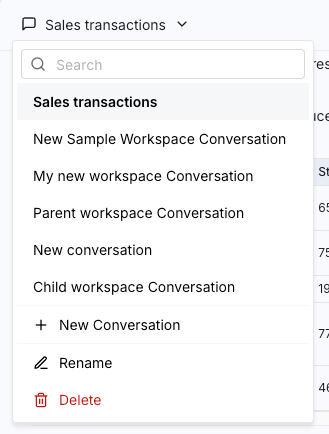
From the Structural Agent chat, to start a new conversation, click the conversation dropdown, then select **New Conversation**.

<figure><img src="/files/jng57eMIZUiOFFuEIfd7" alt=""><figcaption><p>Conversation menu for the Structural Agent</p></figcaption></figure>

### Renaming the current conversation

Structural automatically assigns a name to each new conversation, based on the current context.

To assign a new name to the current conversation:

1. Click the conversation dropdown, then click **Rename**.
2. In the name field, provide the new name.
3. Click **Save**.

### Switching to a different conversation

To change to a different conversation, from the conversation dropdown, select the conversation to change to.

### Deleting the current conversation

To delete the current conversation:

1. Click the conversation dropdown, then click **Delete**.
2. On the confirmation panel, click **Delete**.

Structural deletes the current conversation and switches you to the first available conversation.

When you delete a conversation, Structural also removes it from the browser storage.

## Stopping an action

While the Agent is working, to stop the response and cancel the action, in the chat prompt, click the stop response icon.

<figure><img src="/files/OgTXsH2GMgaMJy0JOZZy" alt=""><figcaption><p>Stop response icon in the Structural Agent chat prompt</p></figcaption></figure>

## Undoing and redoing an action

Before it performs an action to modify the workspace, the Agent takes snapshots of the current workspace configuration.

To undo an action, or to revert to a previous point from the current conversation, prompt the Agent.

For example:

* `Undo that action.`
* `Revert the generator assignments for the datetime columns.`
* `Go back to before we assigned generators to the name columns.`

If needed, the Agent can ask you to select a snapshot to revert to.

To redo an action, cick the redo icon.

<figure><img src="/files/GMy5F6xHyjLLTzvB3kWa" alt=""><figcaption><p>Redo icon for the Structural Agent</p></figcaption></figure>

## Copying the most recent response from the Agent

A response from the Agent might be useful elsewhere. For example, you can prompt the Agent to generate Structural API calls, or the Agent might return a useful summary of the data and its status.

To copy the most recent Agent response, click the copy icon.

<figure><img src="/files/Qbwe3WSE9o6YOYnzueEn" alt=""><figcaption><p>Copy response icon for the Structural Agent</p></figcaption></figure>

## Providing feedback to the Agent

You can provide basic positive or negative feedback to indicate the helpfulness of a response. The Agent then uses that feedback to adjust its future responses in the current chat.

To provide positive feedback, click the thumbs up icon.

To provide negative feedback, click the thumbs down icon.


---

# Agent Instructions
This documentation is published with GitBook. GitBook is the documentation platform designed so that both humans and AI agents can read, navigate, and reason over technical content effectively. Learn more at gitbook.com.

## Querying This Documentation
If you need additional information that is not directly available in this page, you can query the documentation dynamically by asking a question.

Perform an HTTP GET request on the current page URL with the `ask` query parameter, and the optional `goal` query parameter:

```
GET https://docs.tonic.ai/app/structural-agent/managing-the-structural-agent-and-agent-chat-conversations.md?ask=<question>&goal=<endgoal>
```

`ask` is the immediate question: it should be specific, self-contained, and written in natural language.
`goal` is optional and describes the broader end goal you are ultimately trying to accomplish on behalf of the user. GitBook uses it to tailor the answer towards what is most useful for that goal.

The response will contain a direct answer to the question and relevant excerpts and sources from the documentation.

Use this mechanism when the answer is not explicitly present in the current page, you need clarification or additional context, or you want to retrieve related documentation sections.