> For the complete documentation index, see [llms.txt](https://docs.tonic.ai/llms.txt). Markdown versions of documentation pages are available by appending `.md` to page URLs; this page is available as [Markdown](https://docs.tonic.ai/textual/tonic-textual-guide.md).

# Tonic Textual guide

Tonic Textual allows you to put your text-based data to work for you.

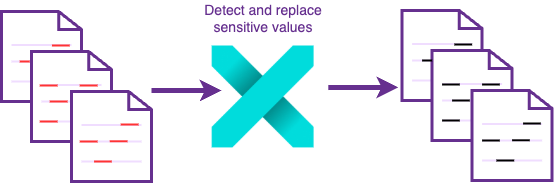
A Textual dataset is a collection of files from a local file system or cloud storage. Textual scans the dataset files to identify sensitive values. You can then choose to redact or replace those sensitive values, to produce output files in the same format that you can safely use for development and training.

A guided redaction project identifies blocks out sensitive values in files. For example, you might use guided redaction to prepare documents in response to a Freedom of Information Act request. Textual scans the files to identify values. You can then review and adjust the results before you download the output files.

You can use the Textual Python SDK or the Textual REST API to manage datasets or to remove sensitive values from individual text strings and files.

<figure><img src="https://3072847115-files.gitbook.io/~/files/v0/b/gitbook-x-prod.appspot.com/o/spaces%2FvOPn7KQptPWmS5iKg5P0%2Fuploads%2FFCVbjB84XZ90q3QRQpJ0%2FTextualOverview_Combined.png?alt=media&amp;token=9254150b-fe96-400f-b274-fc12f3a8a4b9" alt=""><figcaption></figcaption></figure>

Want to know what's in the latest Textual releases? Go to the [Textual release notes](https://www.tonic.ai/product-release-notes/textual).

To explore Textual tutorial and demo videos, go to the [Textual playlist](https://www.youtube.com/playlist?list=PLahjS-TeeUbXHNYdlcqlG2LjhkNAuk0A1).

## Startup and overview

<table data-view="cards"><thead><tr><th></th><th></th><th></th><th data-hidden data-card-target data-type="content-ref"></th></tr></thead><tbody><tr><td><strong>Getting started with Textual</strong></td><td>Sign up for a Textual account.</td><td></td><td><a href="/textual/tonic-textual-getting-started.md">Getting started with Textual</a></td></tr><tr><td><strong>Textual entity types</strong></td><td>Built-in entity types come with Textual. You can also configure custom entity types.</td><td></td><td><a href="/textual/entity-types/about-entity-types.md">About entity types</a></td></tr><tr><td><strong>Preview Textual detection and redaction</strong></td><td>Use the home page to see how Textual identifies sensitive values in text or a file.</td><td></td><td><a href="/textual/textual-playground.md">Previewing Textual detection and redaction</a></td></tr><tr><td><strong>Textual Agent</strong></td><td>Use the AI-based agent to explore and configure a dataset.</td><td></td><td><a href="/textual/textual-agent/textual-agent-about.md">About the Textual Agent</a></td></tr><tr><td><strong>Datasets workflow</strong></td><td>Use Textual to detect and replace sensitive values in files.</td><td></td><td><a href="/textual/datasets-create-manage/datasets-flows.md">Datasets flows</a></td></tr><tr><td><strong>About guided redaction (beta)</strong></td><td>Use Textual to identify and block out sensitive values in files.</td><td></td><td><a href="/textual/guided-redaction/guided-redaction-about.md">About guided redaction</a></td></tr></tbody></table>

## Textual Python SDK, REST API, and other integrations

<table data-view="cards"><thead><tr><th></th><th></th><th></th><th data-hidden data-card-target data-type="content-ref"></th></tr></thead><tbody><tr><td><strong>Manage API keys</strong></td><td>Generate and revoke API keys for SDK and API authentication.</td><td></td><td><a href="/textual/tonic-textual-api/textual-api-keys.md">Creating and revoking Textual API keys</a></td></tr><tr><td><strong>Python SDK</strong></td><td>Use the Textual Python SDK to redact text and manage datasets.</td><td></td><td><a href="/textual/tonic-textual-api/textual-python-sdk.md">Textual Python SDK</a></td></tr><tr><td><strong>REST API</strong></td><td>Use the Textual REST API to redact text strings, manage datasets, and manage user access.</td><td></td><td><a href="/textual/tonic-textual-api/textual-rest-api.md">Textual REST API</a></td></tr><tr><td><strong>Audit redaction requests</strong></td><td>Use an LLM to review the quality of the detection for your redaction requests.</td><td></td><td><a href="/textual/tonic-textual-api/request-auditor.md">Auditing redaction requests</a></td></tr><tr><td><strong>Textual MCP server</strong></td><td>Send Textual requests from an external AI agent.</td><td></td><td><a href="/textual/tonic-textual-api/textual-mcp-server.md">Using the Textual MCP server</a></td></tr><tr><td><strong>Textual integrations</strong></td><td>List of Textual integrations with other products.</td><td></td><td><a href="/textual/textual-integrations/textual-integration-summary.md">Textual integration summary</a></td></tr></tbody></table>

To check the operational status of Textual Cloud, go to [status.tonic.ai](https://status.tonic.ai).

Need help with Textual? Contact <support@tonic.ai>.


---

# Agent Instructions
This documentation is published with GitBook. GitBook is the documentation platform designed so that both humans and AI agents can read, navigate, and reason over technical content effectively. Learn more at gitbook.com.

## Querying This Documentation
If you need additional information that is not directly available in this page, you can query the documentation by asking a question.

Perform an HTTP GET request on the following URL with the `ask` and `goal` query parameters:

```
GET https://docs.tonic.ai/textual/tonic-textual-guide.md?ask=<question>&goal=<user_goal>
```

`ask` is the immediate question: it should be specific, self-contained, and written in natural language.
`goal` is what the user is ultimately trying to achieve, the reason they need the answer. Sharing it helps GitBook give you a better, more relevant answer. A goal is most helpful when it describes the outcome the user wants rather than restating the question. For example, with `ask=how do I create an API token`, a goal like `automate deployments from our CI pipeline` lets GitBook tailor the answer to that use case.

The response will contain a direct answer to the question and relevant excerpts and sources from the documentation.

Use this mechanism when the answer is not explicitly present in the current page, you need clarification or additional context, or you want to retrieve related documentation sections.